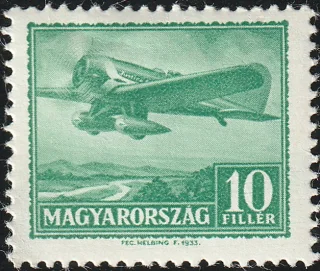
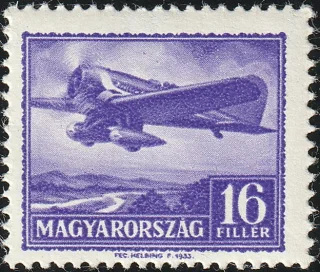
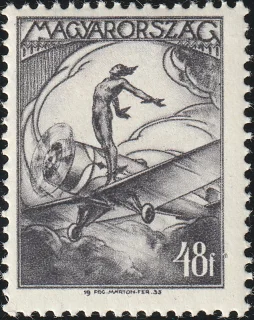
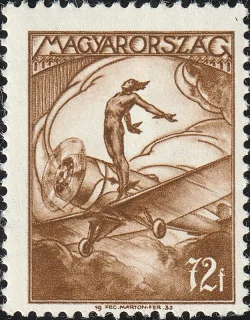
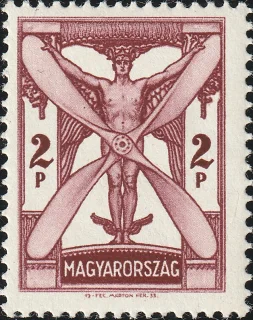
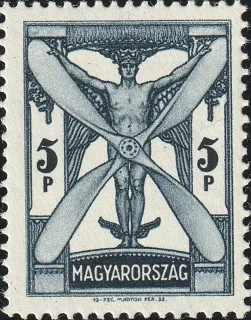
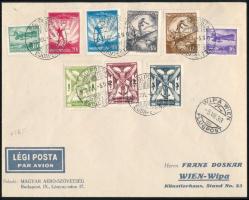
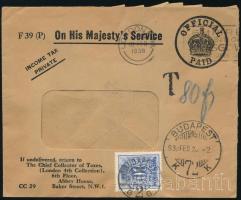
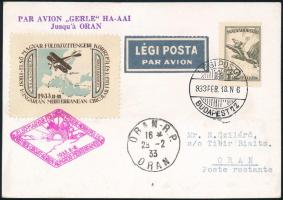
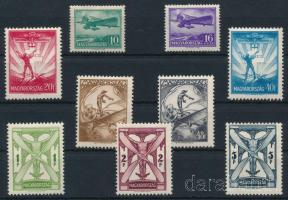
The 1933 Airmail (II) issue is perhaps the most distinctive of Hungary’s aviation-themed sets. The two lower denominations were designed by Ferenc Helbing and the remaining values by Ferenc Márton. The 10- and 16-fillér stamps depict the Lockheed Sirius 8A aircraft named Justice for Hungary, flown by navigator Sándor Magyar and pilot György Endresz, who in 1931 became the first Hungarians to cross the Atlantic by air. The purpose of the flight was to draw attention to calls for an ethnic revision of the borders established by the Treaty of Trianon. In the spring of 1932, Endresz was invited to the World Congress of Ocean Flyers in Rome. He asked Captain Gyula Bittay to serve as radio operator. On 21 May, a few minutes after 3 p.m., the Lockheed exploded in the air for unknown reasons near Rome’s Littorio airfield and crashed into the surrounding hills. Both occupants were killed.
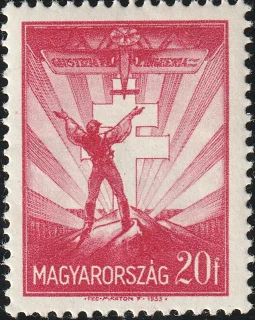
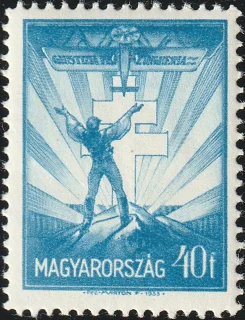
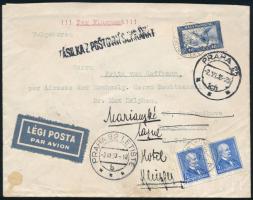
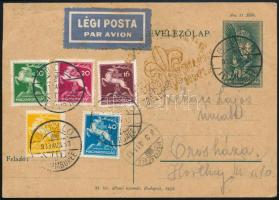
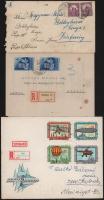
The 20- and 40-fillér stamps depict a two-seat FIAT BR.3 biplane named Giustizia per l’Ungheria (“Justice for Hungary”), donated to Hungary by Mussolini’s government after the Justice for Hungary tragedy. The FIAT BR.3 became one of the symbols of interwar revisionist policy. The 48- and 72-fillér values show Mercury among the clouds, bracing his naked body against the direction of flight on the left wing of an aeroplane, with his arms swept backwards. The 1-, 2- and 5-pengő values also depict Mercury, holding a four-bladed propeller in front of him with outstretched arms. A notable feature of the issue is that the Czechoslovak postal administration refused to recognise the 20- and 40-fillér stamps because of the inscription GIUSTIZIA PER L’UNGHERIA, referring to Trianon; mail bearing them was not delivered but returned to sender.