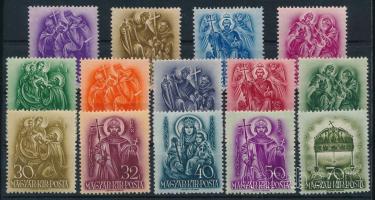
The idea of holding an International Eucharistic Congress in Budapest in 1938 had already arisen in 1926, when Cardinal-Prince Primate János Csernoch returned from the Eucharistic Congress then being held in Chicago. As a kind of trial, a national Eucharistic congress was held in Hungary in 1928 with some 200,000 participants. Encouraged by its success, the Hungarian episcopate formally began discussing the possibility of hosting an international Eucharistic congress at its meeting the following year. The international event in Hungary was scheduled for 1938, the 900th anniversary of the death of St Stephen.
The congress was preceded by an enormous organisational effort. The Hungarian organisers wanted to demonstrate that Hungary, constrained both politically and economically, could nevertheless stage an event of worldwide significance.
The event was also intended to demonstrate the strength of the Hungarian Catholic Church and its unity with the universal Church. Many participants, explicitly or implicitly, regarded the Budapest celebrations not only as a means of deepening spiritual life but also as a political statement against German National Socialism. This was evident enough for Hitler to prohibit German Catholics from attending. At the same time, the congress also conveyed a message towards the other principal enemy identified by the organisers: “pagan” Bolshevism.
The major international event was linked with a large programme of Hungarian celebrations marking the 900th anniversary of the death of the canonised king and bringing the powerful St Stephen cult of the 1930s to its culmination. Together, these events deliberately sought to demonstrate that Hungary could once again fulfil its centuries-old role as the “bulwark of Christianity”, once again standing, in contemporary rhetoric, “between two pagan powers”. The celebrations of the “Double Holy Year”, both at home and abroad, presented Hungary—during what would prove to be the last year of peace—as an “island of peace in Central Europe”.
As a Reformed Protestant, Regent Miklós Horthy could not naturally serve as patron of the Catholic congress, so the role of patroness was given to his Roman Catholic wife, Magdolna Purgly. The congress was organised on a spectacular and grand scale. Delegates and guests arrived from 33 countries, numbering around 50,000, while Hungarian participation at some events reached as many as half a million. Processions involving tens of thousands of people, special night-time Eucharistic adoration, Masses attended by hundreds of thousands, magnificent illumination of Budapest and the large, colourful gathering of visitors made the event memorable for believers and non-believers alike. Contemporary newsreels reporting on the event can be viewed at the end of the article.
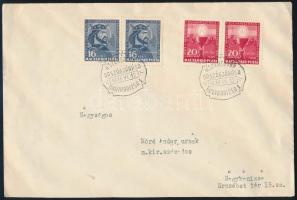
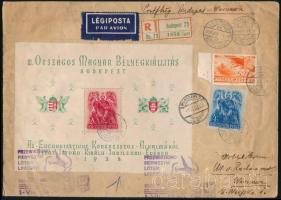
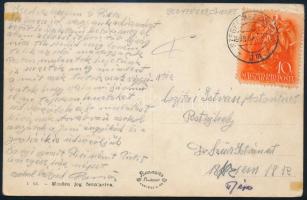
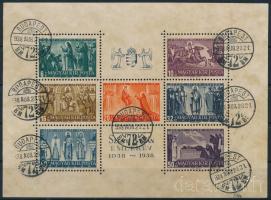
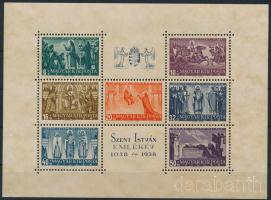
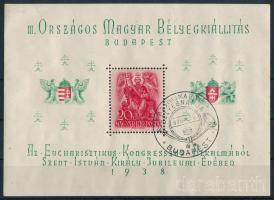
For the event held in Budapest from 25 to 29 May 1938, the postal administration issued a commemorative souvenir sheet containing seven denominations with a 100% surcharge. The Central Press Company had proposed the issue as early as 1935, and the Council of Ministers accepted the proposal submitted by the postal administration. A competition was announced for the stamp design. Eleven artists were invited, nine of whom submitted entries. The jury awarded the first prize of 1,000 pengő to Lajos Márton, the second prize of 700 pengő to Antal Fery, and the third prize of 400 pengő to Emil Englerth. Before issue, the organising committee undertook to purchase 40,000 souvenir sheets, but after the print quantity was increased from 100,000 to 250,000 it refused to take delivery, leading to litigation. A total of 103,755 souvenir sheets were destroyed.

 MBK 601
 MBK 602
 MBK 603
 MBK 604
 MBK 605
 MBK 606
 MBK 607
 MBK 604Tny-blokk