Log in / Register

← Back to year

Hungary · 1900

Turul and Franz Joseph I (1900)

Share your knowledge and photos

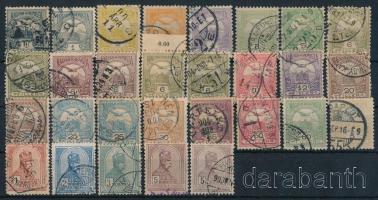
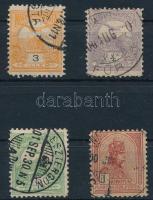
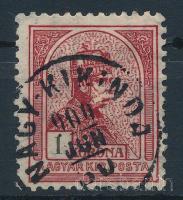
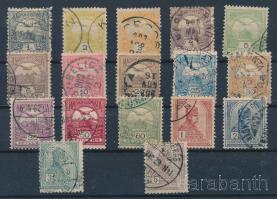
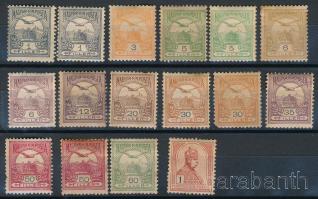
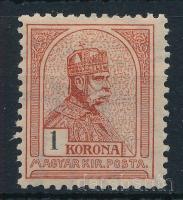
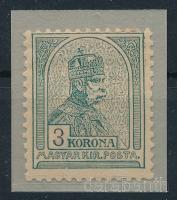
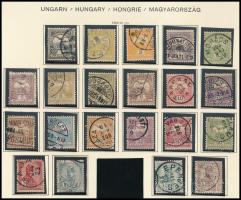
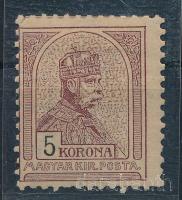
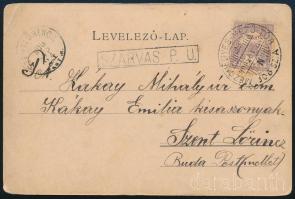
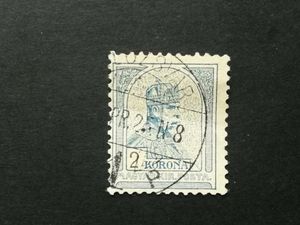
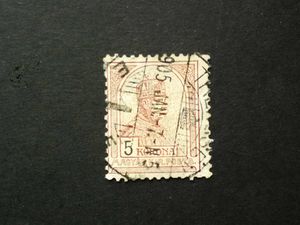
A new currency system was introduced in Hungary on the first day of the 20th century. From 1 January 1900, the krajczár was replaced by the fillér and the forint by the korona. Changes in postal rates also required new stamps. A public competition was held to replace the “Krajczár” issue, which had then been in use for 26 years. The fillér denominations, based on designs by János Bőhm, depict a traditional sweep well, the Hungarian plain, the Turul and the Holy Crown. The korona values were designed by Ödön Tull and show a bust of Franz Joseph I. The stamps were typographed in two separate operations, with the stamp design and denomination numeral printed separately, in printing sheets of 4 × 100 stamps. They remained in use for 18 years. Although apparently uniform, the issue is in fact highly varied and is a favourite of many collectors: over those 18 years the stamps appeared on papers with five different watermarks and with three different perforations, and more than two billion examples were printed. Numerous watermark positions, colour shades, catalogued plate flaws and marginal printer’s markings are known.
This issue marked the beginning of a new philatelic era: it was the first issue of Hungary’s korona–fillér stamps.

Turul above the Crown of St Stephen

MBK:
69
Date of issue:
1900.01.01
Face value:
2 fi
Colour:
olive-yellow
Watermark:
III. Large crown watermark around
Perforation:
12 : 11 3/4
Variants:
12

Turul above the Crown of St Stephen

MBK:
73
Date of issue:
1900.01.01
Face value:
6 fi
Colour:
purplish brown
Watermark:
III. Large crown watermark around
Perforation:
12 : 11 3/4
Variants:
12

Turul above the Crown of St Stephen

MBK:
74
Date of issue:
1902.01.01
Face value:
6 fi
Colour:
greenish olive
Watermark:
III. Large crown watermark around
Perforation:
12 : 11 3/4
Variants:
13

Turul above the Crown of St Stephen

MBK:
75
Date of issue:
1900.01.01
Face value:
10 fi
Colour:
rose-carmine
Watermark:
III. Large crown watermark around
Perforation:
12 : 11 3/4
Variants:
12

Turul above the Crown of St Stephen

MBK:
76
Date of issue:
1904.01.01
Face value:
12 fi
Colour:
violet
Watermark:
III. Large crown watermark around
Perforation:
12 : 11 3/4
Variants:
10

Turul above the Crown of St Stephen

MBK:
79
Date of issue:
1900.01.01
Face value:
30 fi
Colour:
orange-brown
Watermark:
III. Large crown watermark around
Perforation:
12 : 11 3/4
Variants:
10

Turul above the Crown of St Stephen

MBK:
80
Date of issue:
1900.12.05
Face value:
35 fi
Colour:
red-violet
Watermark:
III. Large crown watermark around
Perforation:
12 : 11 3/4
Variants:
11

Turul above the Crown of St Stephen

MBK:
81
Date of issue:
1900.01.01
Face value:
50 fi
Colour:
carmine-red
Watermark:
III. Large crown watermark around
Perforation:
12 : 11 3/4
Variants:
10

Turul above the Crown of St Stephen

MBK:
82
Date of issue:
1900.01.01
Face value:
60 fi
Colour:
olive-green
Watermark:
III. Large crown watermark around
Perforation:
12 : 11 3/4
Variants:
10

Franz Joseph I

MBK:
83
Date of issue:
1900.01.01
Face value:
1 K
Colour:
brownish red
Watermark:
III. Large crown watermark around
Perforation:
12 : 11 3/4
Variants:
10

Franz Joseph I

MBK:
84
Date of issue:
1900.12.05
Face value:
2 K
Colour:
greyish blue
Watermark:
III. Large crown watermark around
Perforation:
12 : 11 3/4
Variants:
10

Franz Joseph I

MBK:
85
Date of issue:
1900.01.01
Face value:
3 K
Colour:
blue-green
Watermark:
III. Large crown watermark around
Perforation:
12 : 11 3/4
Variants:
10

Franz Joseph I

MBK:
86
Date of issue:
1900.12.05
Face value:
5 K
Colour:
brownish purple
Watermark:
III. Large crown watermark around
Perforation:
12 : 11 3/4
Variants:
10
Sources Most of the data and descriptions published on this page are based on publications listed in the Bibliography section. Due to differences between sources and possible processing errors, the content is provided for information only. Market prices are estimated by analysing listings from online marketplaces and auction houses. The actual value of an individual stamp may differ. Bibliography

Market prices

Prices are available after login

Log in to view estimated market prices in forints or euros.

Log in to view

Special variant

6

Errors, printing flaws and other rarities:

6

What else should you look for?

Errors and curiosities found on stamps in this series

The stamps can occur in many additional colour shades. Most of the inks are water-soluble, so some soaked examples may appear faded. 
A premium is justified for plate flaws.
Double impressions, machine set-offs and sheet set-offs may occur and can add substantial value.
On the 1-korona denomination, show-through or bleed-through of the print is common (the red ink is also visible on the reverse). This is a normal characteristic of this denomination and does not add value.
Marginal printing control marks or sheet-total numbers may also add value.
The 4, 5, 10, 25 and 35 fillér denominations were also issued in stamp booklets.  

Forgeries:
Unused stamps are very rare, so regumming is known!

Related auction offers

Related Vatera offers