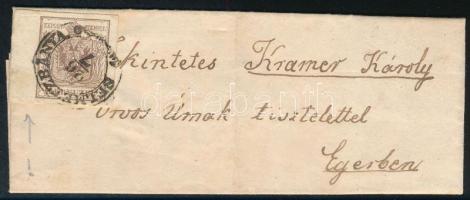
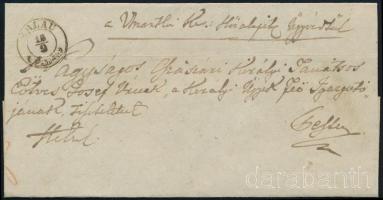
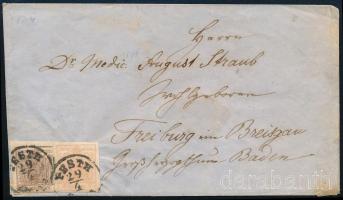
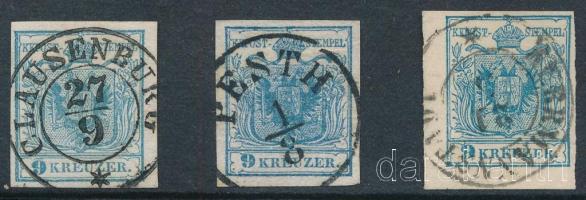
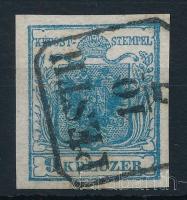
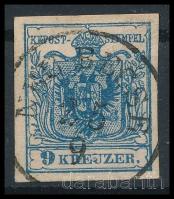
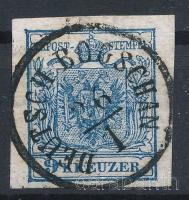
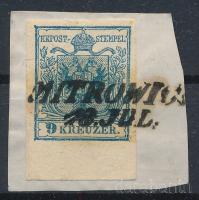
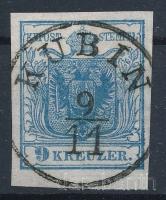
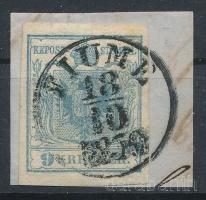
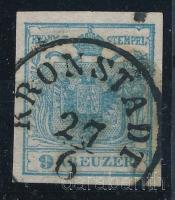
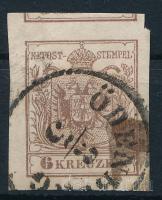
The stamps of this issue can primarily be classified according to the type of paper used. On this basis, we distinguish handmade (handmade-wove) paper, which is grainier and greyer, from machine-made paper, which is smoother, more uniform and whiter.
In addition, three types of the stamps are distinguished. Their characteristic features are summarised in the table below:
| Location of the distinguishing feature on the stamp design |
Type I1, 2, 3 and 6 kr, as well as those 9 kr stamps on which the denomination numeral sits lower than the baseline of the word KREUZER. | Type II9 kr only | Type III1, 2, 3, 6 and 9 kr |
|---|---|---|---|
| The shield | In its original state; the dots are rounded and separate. | The Type II 9 kr is essentially a stamp with the distinguishing features of Type I, but with the numeral 9 aligned with the baseline of the letters in KREUZER. | The dot pattern was re-engraved twice (diamond-shaped) or three times (triangular). |
| The outline of the shield | Usually solidly inked (with a thin dividing line on fine impressions). | Conspicuously divided by a broad white band. | |
| The dots below the eagle’s claw holding the orb | Slightly slanted; the two dots nearest the eagle merge together. | Separate and aligned horizontally. | |
| The denomination numeral | Touches the upper ornamental line of the value tablet (1, 2, 3 and 6 kr). On the 9 kr stamp, it is not aligned with the baseline of the word KREUZER. |
Does not touch the inner (upper) ornamental line. |